
For many people, figuring out how to talk to a parent about assisted living is one of the hardest conversations to start. It’s not just about logistics. It’s about roles changing, independence, and the reality that someone who once cared for you may now need support.
The best way to talk to a parent about assisted living is to start the conversation early when possible, focus on support rather than control, and approach it as an ongoing discussion rather than a one-time decision.
If you’re unsure how to begin, you’re not alone. It doesn’t have to be perfect. It just has to start somewhere.

When Should You Have The Conversation?
You’ll often hear that this conversation should happen early, before support is needed. That can make things easier, but it doesn’t always happen that way.
Many families don’t start the conversation until something changes that prompts them to feel that it’s time to consider assisted living. That might be a fall, missed medications, or a noticeable shift in daily routines.
At Cappella of Grand Junction, we often meet families who are trying to figure this out in real time. If that sounds familiar, you’re not behind. You’re responding to what’s happening now, and that matters.
How To Prepare Before Talking To Your Parent
Before sitting down together, it helps to have a general sense of the options available for additional support. Taking a little time to do your homework ahead of the conversation can make it feel more grounded and less reactive.

Understand available support options
Home care and assisted living communities are often the two most common paths families consider.
Home care allows someone to remain at home with help for specific tasks. Assisted living provides a community setting with meals, housing, and support with activities of daily living like dressing, bathing, or medication reminders.
Both options can work depending on the situation. One of the main differences is consistency. In an assisted living setting, support is already part of the day-to-day environment.
Look At The Full Picture Of Cost
A home that is already paid off can feel like the more affordable option. At the same time, there are ongoing expenses that can add up, including maintenance, utilities, transportation, and in-home care.
It can be helpful to step back and look at what daily life actually requires, both financially and practically. Compare the costs of assisted living and home care.
Consider Social Connection
As people age, social circles often become smaller without much notice. That can affect both emotional and physical health.
According to the National Institute on Aging, social isolation has been linked to higher risks of serious health conditions and cognitive decline.
Having regular opportunities to connect with others can make a meaningful difference in day-to-day life.

Be Aware Of Outdated Perceptions
Many people still picture senior living as institutional or restrictive. In reality, today’s communities are designed to be supportive and engaging.
At Cappella of Grand Junction, the focus is on creating an environment that feels comfortable and familiar, with routines, activities, and support that adapt to each person.
How Do You Have The Conversation With Your Parent About Assisted Living?
Once you feel prepared, how you approach the conversation about assisted living matters just as much as what you say.
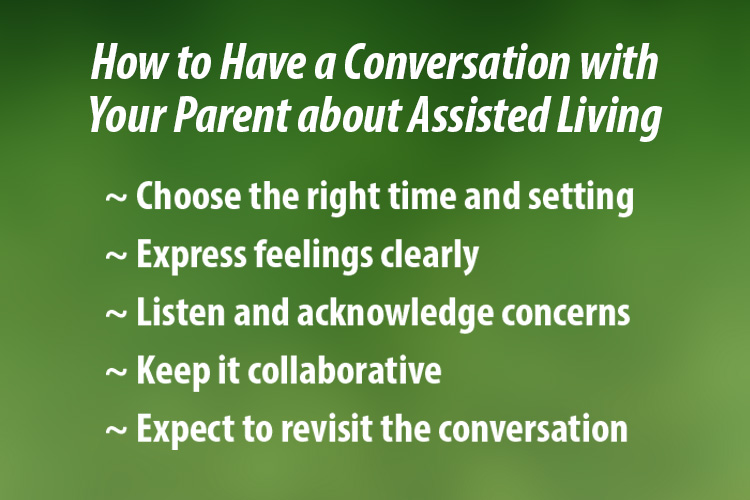
- Choose the right time and setting – Try to bring it up in a calm, familiar environment. Starting the conversation during a stressful moment can make it harder for everyone to stay open.
- Express feelings clearly – Using “I” statements can help keep the conversation grounded. For example: “I’ve noticed it’s been harder to keep up with things around the house, and I want to make sure you’re supported.”
- Listen and acknowledge concerns – It’s important to give your parent space to share how they feel. Concerns about independence, routine, and change are all valid. Taking time to listen can make future conversations easier.
- Keep it collaborative – This works best when it feels like a shared conversation. Focusing on what would make daily life easier or safer can help move things forward.
- Expect to revisit the conversation – Most families don’t resolve everything in one discussion. That’s normal. Coming back to the conversation over time can help everyone feel more comfortable.
What Should You Avoid When Talking Yo Your Parents About Assisted Living?
Even with good intentions, certain approaches can make the conversation more difficult.
- Don’t bring it up in the middle of a stressful situation
- Don’t present decisions as already made
- Don’t focus only on limitations
- Don’t rush the process
Keeping the conversation steady and open tends to be more effective over time.
What Happens Next?
After the initial conversation, the next steps usually happen gradually.
- Continue the conversation – Give your parent time to think about what was discussed. Revisit the topic when it feels appropriate.
- Explore options together – Visiting a community can help make things feel more familiar and less abstract. It also allows your parent to stay involved in the process.
- Consider a short-term stay – Some communities, such as Cappella of Grand Junction, offer respite stays, which give people a chance to experience daily life before making a long-term decision.
- Involve someone they trust – A doctor, advisor, or trusted friend can sometimes help reinforce the conversation in a genuine, familiar way.
Starting this conversation can feel overwhelming, but you don’t have to figure it out on your own. Many families come to Cappella of Grand Junction at different points in the process, some just beginning to explore options, others trying to make decisions more quickly.
What often helps is seeing what daily life actually looks like in a community setting. At Cappella of Grand Junction, the focus is on creating a place where people feel comfortable, connected, and supported in a way that fits their routines and preferences. Residents have opportunities to build relationships, stay engaged, and continue doing the things that matter to them.
If you’re thinking about next steps, we invite you to come visit, ask questions, and get a better sense of what this could look like for your family. There’s no pressure to decide anything right away, just a chance to explore and see if it feels like the right fit.